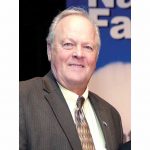

Paul Olson
Olson said as the ag industry continues to consolidate, marketing commodities is that much more difficult for producers. And when farmers look to government for help, they are most often disappointed. “History has taught me that lobbying in Washington with National Farmers members’ money is not a good return on their investment.”
Olson is still as optimistic as ever that when farmers work together, they make a difference in the marketplace. “I believe with the staff and marketing programs we have at National Farmers, producers still have the tools they need to make things better on their farms.”
Vice President Jim Hayes echoed Olson’s comments in his address. He underscored that with fewer markets available to farmers, competition is diminishing and producers suffer. He said markets are being negatively impacted by government policies as corporate giants lobby for their own interests.
He stressed the organization is working hard to create opportunities for farmers and will continue to seek out more partnerships to benefit them.

Rene Niese
Niese Reviews 70 Year History
Former National Farmers vice president Rene Niese began Convene with a look back over its 70 year history. He said the organization began, and continues today, because of the members, staff and leaders dedicated to a central ideal – that farmers are the backbone of this country and should be paid a fair price for their product.
He reminded the audience of National Farmers’ struggles and accomplishments. The veterans returning from war in the 50s realized they couldn’t rely on government programs to help sustain their farm.
“These men soon realized if farmers were to be successful and enable the land to remain in their family, they must stand together as brothers and believe what they were doing was right.”
The organization began in Corning, Iowa, and bylaws were written in 1957. Soon “people were aware of who we were and what we stood for,” Niese said. Founding members were adamant that the organization begin as a nonprofit and not a co-op.

“Our members’ confidence was then, and remains, our number one priority,” Niese noted.
“Throughout the years, there have been holding actions, antitrust lawsuits blocking milk sales, and challenges with banks. The bottom has dropped out of farm real estate prices more than once, banks have closed, and commodity prices have tanked, but National Farmers has stood beside our members, supporting them in the best way we could think of to ensure our farm families are strong and are able to pass the farm to the next generation.“
ISU Ag Innovation Lab Highlights New Ag Tools
At Convene ’26, Iowa State Digital Innovation Lab representative Luke Fuhrer spoke about technology and the advancements it has enabled in the ag industry. “Automation has brought self-driving tractors, enormous advances in data collection and interpretation,” he said. All aspects of farming from monitoring soil conditions to seeding and spraying, all the way to harvest, have been impacted.
Fuhrer said automation and robotics are coming into ag at a record pace. Widespread adoption of GPS, yield mapping, and soil sampling technology is leading to adjustments in fertilizer application that can save farmers money and reduce environmental concerns.
Advanced automation is seen in planters that detect changes in topography and soils, adjusting everything from tension, speed and seed dispersal.
Combines have yield monitors and data collection, enabling farmers to adjust management accordingly. Newer models can self-adjust speed during harvest to coincide with yield and can even self-unload. “Technology can be expensive at the onset, but the return on investment can be significant,” Fuhrer said. Applying on-farm data to decisions can help farmers save time and money on fertilizer and chemical applications by reducing the amount applied and applying them only where necessary.
Drones and robotics are also being adapted to serve farmers and will bring a new wave of advances. Fuhrer sees technology being integrated onto farms to reduce input costs while boosting and improving environmental stewardship, but cautions each producer to evaluate where the tech can be utilized to produce the greatest benefit.

Luke Fuhrer
Brad Rach
Commodity Day At Convene
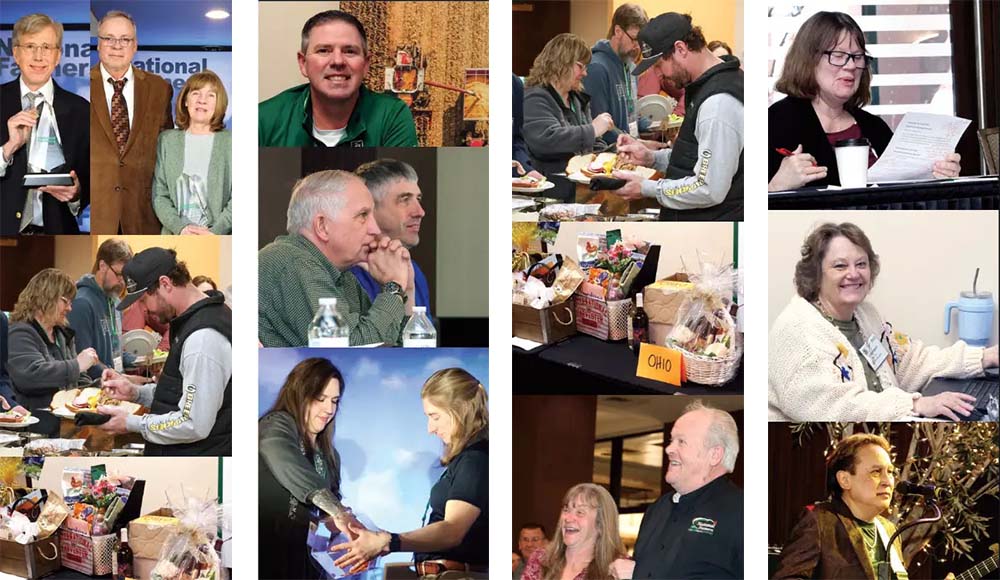
Commodity day at Convene 2026 featured speakers from the dairy, grain and livestock divisions.
Starting the session, Dairy Director Brad Rach began by emphasizing National Farmers is a team, as board members, staff, and family farmers work together to protect and preserve family farms.
“Together Everyone Accomplishes More is what TEAM, and National Farmers is all about,” Rach said.
He explained that better premiums, better market access, and better strategies are needed to combat the continuing consolidation and increasing regulations facing the dairy industry.
Tom Crosby, Midwest Regional Director, and Andy Bousman, Mideast Regional Dairy Director, also took the stage. Crosby informed the audience about the Dairy Margin Coverage (DMC) program. The DMC is a voluntary USDA risk management tool designed to financially support dairy farmers when the margin between the all-milk price and the average feed cost falls below a coverage level chosen by the producer.
Tom Crosby
“We are suggesting a floor for the feed index price of $13.00.” The proposed change that National Farmers is suggesting will enable the program to provide a safety net for dairy farmers as originally intended, Crosby said.
Andy Bousman spoke about the advantages of using social media and podcasts. Social media and podcasting speed communications, add visibility and reach more people. He sees these platforms as valuable education tools able to build trust, enhance relationships, and enable organizations to produce stories that will impact others.
“These platforms can enhance the tools we already use and further the reach and marketing efforts of National Farmers,” Bousman said.

Pete Hardin
“Dairy farmers are not getting enough support from our government,” he said. The conflict in Iran is and will continue to impact the ag industry. “This Black Swan event is raising energy costs. We will pay more for fuel and fertilizer, and exports will decrease,” Hardin said.
Overall, we are seeing a decrease in demand for dairy products, and the decline of support for nutritional programs is adding to the problem. Milk prices are inadequate, but there are bright spots. “There is a shortage of milk in the Northeast, which presents opportunities for National Farmers,” Hardin said. Milk plants are being built, and others are expanding, particularly in New York. And butter and cheese inventories are low, which will support those commodity prices.
He agreed with Tom Crosby’s assessment that the DMC isn’t working and that the feed index calculation needs adjusted. “We need dairy nutritionists to calculate the feed index and include mineral costs and regional differences,” he said. He reccomended farmers make some noise, contact their representatives and push for changes. Because buy-in costs to the program are high and payout is often low or nonexistent, dairy farmers are not signing up.
He believes the signup period should be reopened and become retroactive. Going forward, he cautioned dairy farmers to pay attention to their milk buyers’ observations concerning oversupply, forward-contract grain to avoid price hikes, and take the availability of replacement heifers into account when making breeding choices. Hardin offered his assistance in contacting the right people in Washington and said, “National Farmers is leading the charge and advocating for dairy farmers.”
“As last year,” Rose said, “fed cattle numbers are tight.” The industry is beginning to retain some heifers. Feed costs and the prices for all classes are high. He cautioned producers to lock in a profit and be aware of rising input costs. “Margins are tight and the price of calves and yearlings will remain high. You need to keep feed costs in check, even though fats and culls are bringing good money.”
The industry is adjusting to fewer cattle, as evidenced by plant closures such as the Tyson plant in Lexington, NE. “Tyson has said, even with the closure, they will kill the same number of cattle,” he reported. “Small, regional plants like Upper Iowa Beef are strong, which is good for our members.”
Rose sees packers looking for cull cattle since cull numbers are also down. “Cattlemen are handling more money but not necessarily making more,” Rose said. Given the current market, he noted that there is a greater risk of losing money. His advice – “Utilize risk marketing strategies and lock in profits when you can.”
Pat Lampert
Travis Thomas, procurement manager with Upper Iowa Beef near Lime Springs, Iowa, spoke about this family-owned processing plant and the state of the beef industry at Convene 2026.
The Angus only plant processes 125 thousand head a year, with 80 to 90 percent of those grading upper choice or prime. Selling meat to family distributors, their products are in 31 states and 11 countries.
Purchasing the facility in 2017, the Neiwarner family from Albion, NE wanted to get closer to consumers. “We have the same values as National Farmers,” Thomas stated.
Upper Iowa Beef is committed to serving consumers and cattle producers with the same dedication and transparency. Partnering with producers, the facility provides important yield and grading data on each load of cattle. Thomas noted they give each producer information on their cattle so they can make management adjustments, resulting in more profit for the producer and a better product for consumers.
Jeff Rose
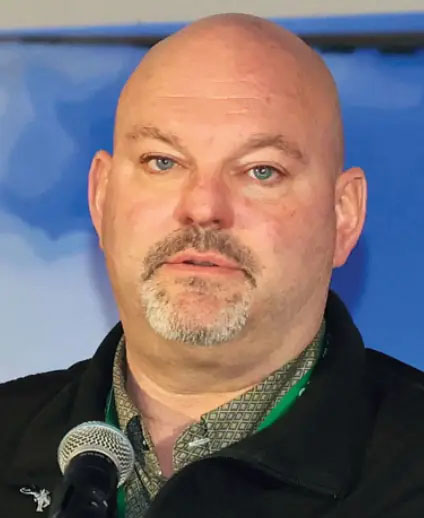
Travis Thomas
A believer in risk management, he reminded producers, “When there is a profit, do something.”
Most of the plant’s beef is sourced from producers within 80 miles. “The cattle are less stressed and we have more flexibility to work with producers,” he said. Not only can the facility call on producers when they need cattle, but they also take small loads of cattle. “We can forward contract and remain flexible on delivery dates and spread out the total number of head to accommodate our producers,” Thomas said.
“There are more feeding operations in the Midwest due to water and feed availability, but the operations are small. I don’t believe the industry will see a return to the number of cattle we once had, due in part to the age of current producers, high start-up costs from younger individuals, and the cost of heifers.”
Thomas has concerns about the cattle industry including a trend to produce over-fat cattle, the administration’s belief that beef is too high-priced, exports to China, Mexico and Brazil are down, processing plant closures, and the overall high cost of food. He also said he expects the Mexican border to remain closed and the lack of Mexican cattle, which used to account for four percent of our beef, will impact many of the southern feedlots.
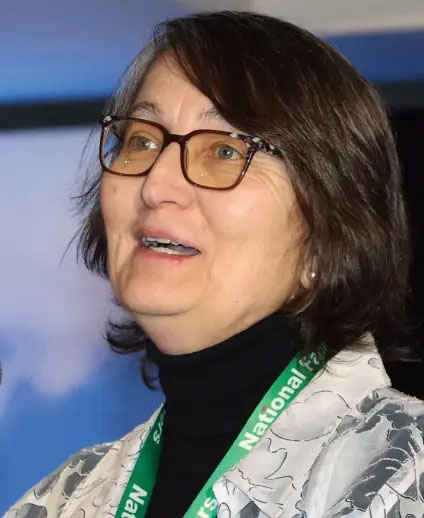
Theresa Seiler
Seiler Leads Grain Division Report
“All of National Farmers’ divisions have the same focus, we are working to support our members,” said Theresa Seiler, Interim Director of the Grain Division.
She reported that seed prices are up and the war in Iran is raising the cost of fuel and fertilizer and the conventional grain markets have been a roller coaster. But, organic grains are seeing an increase in volume and price. “Our volume and cash of organic grains are up over last year. We are seeing our volumes 25 percent higher and cash 22 percent higher. Overall, we are paying our producers $1.00 more per bushel than last year,” Seiler said.
Mike Shulist continued with the organic grain update. “We are seeing new organic markets opening and are developing new relationships,” he noted. There is a new plant in SD producing hemp oil and a group in MN milling conventional oats. Logistics remain a concern for organic producers. “Organics can bring in higher prices, but limited markets mean hauling those grains will add a significant cost.” Schulist also welcomed Melany Thomas, a new grain team member, to the staff.